Monthly Archives: February 2017

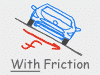
Centripetal Force - Max Speed of Car Around Banked Curve (with friction)

The hardest of these banked turn problems. The bummer is that both friction and normal force are at angles because of the bank, so you have to break them both up into X & Y components. It's not impossible, but it does make for some juicy algebra and trig as you attempt to solve a system of two equations and two unknowns, one of which is stuck inside trig functions!

This video appears on the page: Car & Roller Coaster Centripetal Force Problems

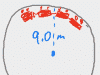
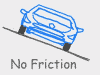
Centripetal Force - Bank Angle For Road To Prevent Car Sliding (no friction)

This is another classic car problem, in which they tell you that the road is so slippery that there is no friction at all, and then they ask you to calculate the angle that the road should be banked to keep the car going nicely through the turn without sliding to the outside or inside of the turn.

This video appears on the page: Car & Roller Coaster Centripetal Force Problems

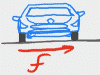
Centripetal Force - Minimum Coefficient of Friction To Prevent Car Skidding

In the first of a few problems about cars going around turns, in this case the road is level - not banked - and we'll calculate the minimum coefficient of static friction to prevent the car from skidding.

This video appears on the page: Car & Roller Coaster Centripetal Force Problems

Roller Coaster Speed at Top of Loop To Maintain Contact With Track

Once again we're setting normal force equal to zero, except this time it's to find the speed at which a roller coaster car "loses contact with the track" or "passengers don't leave their seats".

This video appears on the page: Car & Roller Coaster Centripetal Force Problems

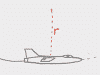
Jet Speed At Top of Loop To Experience Weightlessness

This problem is just like the previous one about a car going over a hump in the road: calculate the speed such that the pilot feels weightless. Once again you're setting normal force equal to zero, except this time it's normal force of air on the wings (or the seat on the pilot's butt) rather than the force of the tires on the road.

This video appears on the page: Car & Roller Coaster Centripetal Force Problems

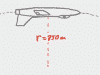
Maximum G-Force At Bottom of Plane Loop-to-Loop

When a military jet does a vertical loop, the pilot is "pulling g's", getting squished down into her seat. In this problem (or similar ones involving roller coasters), they ask you to calculate the minimum radius such that the pilot doesn't pull more than a certain number of g's that would make her pass out.

This video appears on the page: Car & Roller Coaster Centripetal Force Problems

Centripetal Force Problem - Car Doesn't Lose Contact With Ground

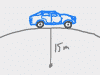
This classic centripetal force problem describes a small hill in a road as "approximately circular", and then asks the maximum speed that a car can go over that hump without "loosing contact with the road", or some other description that translates to "set the normal force equal to zero." Basically: don't do a Dukes of Hazzard over that speed bump!

This video appears on the page: Car & Roller Coaster Centripetal Force Problems

How To Do Car, Plane & Roller Coaster Centripetal Force Problems

All these problems have certain things in common, so this first video takes you through the basics and explains how to see through the blah blah blah of your typical physics problem to recognize the problem underneath.

This video appears on the page: Car & Roller Coaster Centripetal Force Problems

These videos cover lots of examples of centripetal force problems where the object going in a circle is a vehicle. In the case of roller coasters and jets (and some car problems), the circle is usually vertical and you're being asked to find the speed at which the person in the vehicle is "weightless" at the top of the loop (i.e. normal force is zero). In other car problems, the circle is horizontal (a curve in the road), and you're being asked how high to bank the turn or what coefficient of friction would prevent the car from sliding off the road. Examples covered:

Part of the course(s): Physics

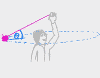
Centripetal Force - Calculate Angle of Conical Pendulum

Even if you're whipping a yo-yo over your head as fast as you can, so that it *looks* like you've made a perfectly flat circle, your hand will actually be a little bit higher than the yo-yo. That's so that the tension in the string has a component upwards, fighting gravity. In this problem, we'll calculate the angle of that droop.

This video appears on the page: Objects Swung In Circles Centripetal Force Problems

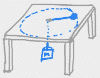
Centripetal Force - Object Rotating On Frictionless Table With Mass Hanging Through Hole

This problem is easier to show than it is to describe (see video thumbnail to the right). The mass hanging down through the table provides the tension on the string, then you're supposed to calculate the radius of the circle which would result in equilibrium.

This video appears on the page: Objects Swung In Circles Centripetal Force Problems

Centripetal Force Problem - Minimum Velocity Before String Goes Slack

This is the other classic centripetal force "mass on string" problem that every class will cover: calculate the minimum speed of an object being swung in a vertical circle such that the string doesn't go slack.

This video appears on the page: Objects Swung In Circles Centripetal Force Problems

Max Velocity Of Object Swung In Circle to Break String

In this example, we are given the "break strength" of the string, then asked to calculate the speed which would result in the string breaking.

This video appears on the page: Objects Swung In Circles Centripetal Force Problems

Object Swung In Vertical Circle - Tension At Top & Bottom Of Circle

One of the first centripetal force problems that physics profs always deal with is the tension at the top and bottom of the swing when the circle is vertical. The tension is higher at the bottom, where gravity is aligned with the fictitious centrifugal force, and tension is lowest at the top, where gravity is "helping" the object move in a circle.

This video appears on the page: Objects Swung In Circles Centripetal Force Problems

How to Solve Centripetal Force Problems About Objects Swung In Circles

Problems about objects swung in circles are all kind of the same once you've got a few under your belt. This first video outlines that process that all these problems have in common, and gives you some tips for what to look for in the word problems to help you know what to solve for.

This video appears on the page: Objects Swung In Circles Centripetal Force Problems

The videos in this chapter cover problems where a mass on a string is being swung around in a circle. Could be a yo-yo, getting whipped in a vertical circle or a horizontal circle around someone's head. Could be a mass on a frictionless table with a weight on the string in a hole in the middle of the table. In each problem, you'll be asked to calculate either the velocity or radius of the circle which would: cause the string to go slack, break the string, or achieve equilibrium. Examples covered:

Part of the course(s): Physics

This problem may not *look* so much worse than the others above it on this page, but believe me, it's nuts. Not only do you have to do a separate free body diagram on the pulley, you have to make some pretty magical assumptions about the accelerations of the two masses.

This video appears on the page: Atwood Machine Force Problems (Pulleys)

Calculating Tension & Advantage of Pulley Systems

This video explains how to tell the difference between pulley systems. Of the three systems in the video to the right, one system requires the person to pull up the full weight of the mass, one requires a pull of just half the weight, and one requires you to pull with DOUBLE the weight. Which is which? And how far would you have to pull the rope in each?

This video appears on the page: Atwood Machine Force Problems (Pulleys)

How to Tell The Difference Between A Pulley System vs Just A Bunch of Pointless Pulleys

This video tries to give you the tricks for spotting when a pulley system is giving a "pulley advantage" (meaning with a given force of tension you can lift a much heavier mass), as opposed to just making the rope snake through a bunch of fixed pulleys without making the job at hand any easier.

This video appears on the page: Atwood Machine Force Problems (Pulleys)

Atwood Machine - Two Masses On Two Inclined Planes

So many classic Atwood Machine problems, so little time! In this one, two inclined ramps are set up back-to-back with a massless rope and pulley connecting them, then they do a tug-o-war! Who will win! Who will lose! One is heavier but one has a steeper angle! The suspense is killing me!

This video appears on the page: Atwood Machine Force Problems (Pulleys)