Monthly Archives: February 2017

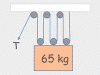
Atwood Machine with Three Masses

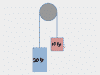
Adding a third mass to an Atwood Machine problem doesn't increase the difficulty of the physics much, but it does make sure you know how to do these problem correctly because it's even more critical to put your coordinate systems in correctly. And having to solve a system of three equations and three unknowns isn't exactly a recipe for *not* making algebraic mistakes.

This video appears on the page: Atwood Machine Force Problems (Pulleys)

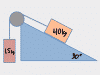
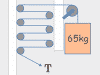
Atwood Example - Hanging Mass Pulling Weight Up Inclined Plane

To take our Atwood Machine excellence one notch further, how about throwing an "inclined plane" (a.k.a. ramp problem) into the mix!

This video appears on the page: Atwood Machine Force Problems (Pulleys)

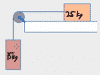
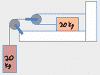
Atwood Machines - Hanging Mass Pulling Object Across Level Surface

This example is the second most common Atwood Machine problem: a hanging mass dragging a second mass across a level, frictionless table.

This video appears on the page: Atwood Machine Force Problems (Pulleys)

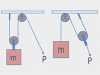
Atwood Example - Two Masses Hanging Vertically From Pulley

This video covers the most basic Atwood Machine example which every class uses (and which I still remember showing up on my first college physics exam as well!). Whether the two objects are anonymous masses, or a monkey and a crate of bananas (my exam again), the process is the same as this general example. I highly recommend watching this one before anything else below.

This video appears on the page: Atwood Machine Force Problems (Pulleys)

How to Solve Atwood Machine Force Problems (Pulleys)s

This video gives you an overview of how to work Atwood Machine problems, which are basically any force problem where you have masses and pulleys. Just like with multiple objects getting pushed or pulled, you'll need to do a free body diagram of each mass. You may even need to do a free body diagram of the pulley. And check out how the coordinate systems go opposite directions for the two masses!

This video appears on the page: Atwood Machine Force Problems (Pulleys)

Atwood machines are a type of F=ma problem where there are at least two masses and a bunch of rope and pulleys, also known as a pulley system. Examples covered:

Part of the course(s): Physics

The videos in this chapter cover word problems about elevators, specifically the ones where they tell you how fast the elevator is accelerating up or down and then ask you how much the scale under the passenger would say the person weighs. Examples covered:

Part of the course(s): Physics

How Far Elevator Traveled Given Weight On Scale

The example in this elevator force problem adds one more wrinkle to the mix: not only is it backwards (they're asking for acceleration rather than giving it to you), there's also a kinematic step added onto the end!

This video appears on the page: Elevator Force & Acceleration Problems

Calculating Weight In Elevator Given Normal Weight

This video covers the super common type of elevator problem where they tell you how much a person weighs normally (when they're not in an elevator), then asks how much they weigh given that the elevator is accelerating up or down at a certain rate.

This video appears on the page: Elevator Force & Acceleration Problems

Elevator Accelerating With A Bunch Of People Aboard

This video covers how to work the type of problem where they tell you the weight of the elevator and its passengers, then they ask you for the tension in the cable supporting the elevator given a certain acceleration.

This video appears on the page: Elevator Force & Acceleration Problems

How To Work Elevator Force & Acceleration Problems

This video gives you an overview of how to work problems about elevators. Big tip: if someone is standing on a scale in an elevator, they're crazy, but perhaps more relevant is that the scale will read their normal force.

This video appears on the page: Elevator Force & Acceleration Problems

The videos in this chapter cover one of the most difficult and time-consuming type of physics force problems that you'll come across: a force pushes or pulls two or three objects that are contacting each other, and you're supposed to find the force between them. Examples covered:

Part of the course(s): Physics

Two Boxes Stacked-Bottom Getting Pushed-Find Friction Coefficient

This video may not seem like it's that bad, since we're back to doing only two objects, but I put it at the end of the chapter for a reason: it's a confusing doozy! If you don't believe me, try working it yourself first, and see if you manage to account for every force that needs to go in the free body diagram of the bottom box (hint: there should be 6).

This video appears on the page: Multiple Objects Getting Pushed or Pulled

Three Objects Getting Pushed From One End (with friction)

In this penultimate multi-object force problem, we have three (count 'em, three!) boxes getting pushed, WITH FRICTION! That is going to be one big steaming pile of algebra, my friends: three equations, three unknowns, and enough substitution to power a city block.

This video appears on the page: Multiple Objects Getting Pushed or Pulled

Find Tension Between Train Cars

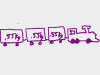
In this multi-object F=ma example we up the level of difficulty by adding a third object to the mix.

This video appears on the page: Multiple Objects Getting Pushed or Pulled

Two Objects Being Pulled Across Floor (with friction)

In this example, we mix things up a bit by having the two objects being pulled rather than pushed, and we're also given the force between the two objects and asked instead for the force pulling them.

This video appears on the page: Multiple Objects Getting Pushed or Pulled

Find Contact Force Between Two Boxes Being Pushed Across Floor (no friction)

Rather than finding the acceleration of the two objects like we did in the previous examples, in this example we'll find the contact force between the two objects.

This video appears on the page: Multiple Objects Getting Pushed or Pulled

Two Objects Pushed Across Floor (with friction)

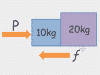
This video handles an example very similar to the previous video, except this time there is friction. That may seem like a small change, but it means quite a bit more math to keep track of, and it adds yet another arrow to each of your free body diagrams!

This video appears on the page: Multiple Objects Getting Pushed or Pulled

Two Boxes Pushed Across Floor (no friction)

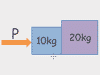
This video explains how to solve the most basic of the multi-object force problems: where a force is pushing two boxes across the floor without friction.

This video appears on the page: Multiple Objects Getting Pushed or Pulled

How To Sove Force Problems With Multiple Objects Getting Pushed or Pulled

This video gives you an overview of the process for the type of problem where multiple objects are involved. The key to the process is that you'll need to do a free body diagram of each mass separately. Be sure to include the forces between the objects (F12, F23, etc.)!

This video appears on the page: Multiple Objects Getting Pushed or Pulled