In case you're in Calculus and wondering how all this rate of change stuff is different now from what you remember from last year (you remember pre-calc perfectly, right?), this video is for you.
This video covers the most common type of rate of change problem, where they give you a function and ask you to find the "average rate of change on the interval [a,b]." In other words, they want you to find the average Y value of a function between two values of x (or t or whatever the independent variable happens to be).
In Algebra, they'll often give you problems - word problems usually - where if you distill it all down, the problem basically gives you the equation of a line and asks for the "rate of change" of some quantity. When in doubt, it's probably the slope (or whatever number is in front of a variable).
In this introductory video, I explain what rate of change means, and how the problems vary between the basic "rate of change" problems in algebra vs the "average rate of change of a function" problems in pre-calculus.
This is a very specific topic where you're told to find the "average rate of change of the function on the interval [a,b]." What that means in English is "plug and chug into your average value formula." And hey, why not find the secant line between those two points while you're at it?
This is a problem you see in lots of physics classes, sometimes involving astronauts or satellites attached by a tether. It turns out that in angular momentum problems, angular momentum is always conserved, but energy isn't. And in a surprise twist, in this problem kinetic energy actually increases! What the what?! That's work, my friend!
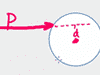
In this problem we look at a classic piece of playground equipment which - like so many of the greats - is pretty hard to find these days, probably because it was too dangerous. But they were all over when I was a kid in the Midwest and they were AWESOME! A great way for kids to learn about centripetal forces, dizziness, the gyro effect, and even negotiating with your friends and their parents to see who was going to push.
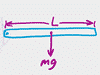
Every book has some version of this problem: sticky projectile collides with a rod that's hinged at one end and you figure out how fast the rod rotates. What a lovely way to combine linear and rotational motion! Maybe your teacher will put it on your test!
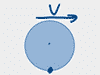
Angular momentum is pretty straightforward except for one little detail: it's kind of funky that you can calculate the angular momentum of an object that's moving in a straight line. Like you could willy nilly calculate the linear momentum of the next jogger you see run past you. Even crazier, since the jogger ins't rotating, you can pick any axis you want, potentially making their angular momentum HUGE if you pick an axis a block away. This video explains that.
Angular momentum is a lot like "regular" momentum: it's conserved. And bizarrely, even an object moving in a straight line has angular momentum. Crazy!
This problem still haunts me from my freshman physics class at Stanford. It was the last problem on the exam, and nobody got it right, including me! But now, applying everything we've learned in the videos up until now, it turns out to not be so bad: just set up your free body diagram, set up your net force and net torque equations, and look for stuff to cancel out.
Hoop vs Solid Disk Rolling Down a Hill of Height h
This one is kind of interesting and almost every class covers it in some way, either in lecture or homework. The question: If you roll a hoop and a disk down the same hill, which goes faster? Whether they weigh the same or one is big and one is small, the answer is the same: the winner is...
This is the hardest problem about rolling, where we step back into torques to try and figure out how fast a sphere accelerates as it rolls down a ramp. You're going to be wishing you could use energy on this one by the time we're done!
In this video we calculate the energy of a rolling cylinder two ways. In the first way, we add up the kinetic energy due to the wheel's movement across the ground and the energy of the rotation. The second time we do it we do it the crazy way, treating the wheel like an object that is rotating not about its center but about the bottom of the wheel where it's touching the ground.
Rolling motion can seem really complicated in lecture, but in this video we go over some of the steps that all these problems have and talk about how these problems are different from old "stuff going down ramps" problems. I also explain one of the weird ways these problems can be done: by treating the contact point as the axis of rotation instead of, you know, the axis of the rolling object.
Rolling is more complicated than you'd think! On the one hand, you've got a mass on the move, so all the usual linear kinematics and energy formulas work. On the other hand, anything that is rolling is also rotating, which means it's got rotational kinetic energy too. It gets a bit complicated, but it's kind of cool if you study it because our lives are full of wheels:
As we previously discovered in linear motion, energy and work make most kinematic problems waaaaaaaay easier to solve than they would be with torque (τ), time, angular acceleration (α), angular displacement (Θ), etc:
You won't see this too much on your homework or exams, but it may pop up as one of the sub-questions on a long problem, so it's worth revisiting power again. As with all things rotational, we'll have slightly different formulas than we did for linear power problems, but the overall effect is the same: how fast was energy put into the system?
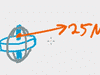
You may recall from earlier in physics that "work" in physics is when you introduce new energy into the problem from some source other than potential energy (mgh). Well, rotational problems are no different: If you want to get that jet engine spinning, an electric starter motor has to spin that up. If that kid wants a gyro toy to spin, she's got to pull that string (preferably with 25N of force for 1.2m).
If you do not have an account, you should get one, because it is awesome! You can save a playlist for each test or each chapter, and save your "greatest hits" into a "watch right before the final" list (not that we recommend cramming, but when in Rome...)