Monthly Archives: February 2017

Hockey Puck Getting Shot By Angled Stick (with Friction)

This video covers a fun example from the world of sports: a hockey player slamming a slap shot! Because the stick acts on the puck at an angle, pre-loading flex into the stick, the stick is pressing the puck into the ice, increasing the friction that acts upon it, which in turn affects the acceleration. Complicated!

This video appears on the page: Friction Forces & Problems

Static Friction of Crate Pressed by Angled Force

This video works an example where they ask you to calculate the static friction force required to resist an angled force.

This video appears on the page: Friction Forces & Problems

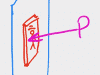
Force Required to Prevent Painting From Sliding Down Wall

This video covers a common example that's covered by most books, though the object isn't always a painting. The basic idea is they'll ask you the normal force (or sometimes μs) required such that the friction will be high enough to prevent an object from sliding down the wall.

This video appears on the page: Friction Forces & Problems

Force Required to Overcome Static Friction

This video explains how to solve the type of problem where they ask you how hard an object must be pushed to "break free" of static friction and start moving (sometimes referred to as "breakaway").

This video appears on the page: Friction Forces & Problems

Static vs Kinetic Friction (μs vs μk)

This video covers the important differences between static and kinetic friction. It also explains why μs is ALWAYS bigger than μk, a fact which is likely to make it onto your next exam in the form of a short answer or multiple choice question!

This video appears on the page: Friction Forces & Problems

How To Solve Friction Problems (F=μN)

This video introduces the main formula you'll need for F=ma problems involving force (F=μN), then shows you how to use it to solve a few basic examples. The key to friction is that the force of friction is perpendicular to the normal force pressing two surfaces together, so friction problems always require both X and Y equations. :(

This video appears on the page: Friction Forces & Problems

First, this chapter explains what the friction force is, how to calculate it, and how to use it in F=ma problems. Then it gets into a bunch of problems covering static friction. Examples covered:

Part of the course(s): Physics

This chapter covers detailed examples of ramp problems involving forces, where you have to: 1) create the free body diagram and not leave out anything; 2) work out your F=ma equations in X and Y; and 3) solve the equations using substitution. Examples covered:

Part of the course(s): Physics

Crate Pulled Up Ramp By Horizontal Force (Difficult, with friction)

This problem might not seem so much worse than others we've seen in the ramp chapter, but it really is. Not only does it have friction, but the force we're solving for is not parallel to the ramp, so it has components in both the X and Y directions. You'll see what I'm talking about: lots of algebra in this one!

This video appears on the page: Ramp Force Problems

How Long To Make A Runaway Truck Ramp (with friction)

This video covers a really cool real-world F=ma application involving ramps: those crazy ramps you'll see shooting off mountain highways, which are designed to stop runaway trucks (big trucks whose brakes have overheated and stopped working).

This video appears on the page: Ramp Force Problems

Find Friction Coefficient (μs) Required To Prevent Box Sliding Down Ramp

This video covers one of those subtle ways that a professor can throw you off your game by asking for something different than they usually do in F=ma problems. In this particular example, rather than asking for acceleration, they ask for the coefficient of static friction μs!

This video appears on the page: Ramp Force Problems

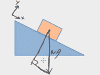
Acceleration Of A Box Down A Ramp (with Friction)

In this ramp problem video, we finally add friction to the mix. But take heart: you'll still get to draw all those crazy components of gravity (the "mg triangle") on the free body diagram that I've tried to convince you to master.

This video appears on the page: Ramp Force Problems

Acceleration of Box Down Frictionless Ramp (with Forces)

The problem in this video can be done without using F=ma, since we did just that back in the Frictionless Ramps Kinematics chapter. As you may recall, we said that for those problems, a=g*cosθ. Well, in this video we show how we got that result, which is a good way to get started on ramp force problems.

This video appears on the page: Ramp Force Problems

F=ma example: Dogs Pulling Dogsled Up Hill (no friction)

This video covers a fun problem where a pack of marginally tame wild dogs is pulling a sled up a snowy embankment.

This video appears on the page: Ramp Force Problems

How To Solve Force Problems Involving Ramps

This video covers the basic strategies and formulas you'll need to solve F=ma problems involving Ramps, which means you're looking at an angled surface or incline up or down which an object is sliding, crashing, or being pulled. If you're not sure about free body diagrams, definitely familiarize yourself with our free body diagram videos.

This video appears on the page: Ramp Force Problems

This chapter covers detailed examples of problems involving an object, crate, or dog sled getting pushed or pulled across a level floor with or without friction:

Part of the course(s): Physics

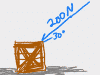
Crate Getting Pulled Across Floor by Angled Rope (with Friction)

This is the toughest of the "stuff getting dragged across a level surface" problems, because there are both friction and an angle of action for the force. So the angled force is lifting the box a bit, which decreases the normal force, which decreases friction.

This video appears on the page: Object Getting Pushed or Pulled Across Floor

Crate Pushed Across Floor by Horizontal Force (with friction)

In this F=ma example, we add friction to the situation of the box getting dragged across the floor by a horizontal force.

This video appears on the page: Object Getting Pushed or Pulled Across Floor

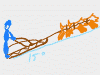
Dogs Pulling Sled Across Level Ground (without friction)

This video covers an F=ma example of a dogs pulling a sled across frictionless ice. What makes this a bit harder than the previous problem is that this time the force (the dog's harness) is pulling up at an angle of 18 degrees instead of level.

This video appears on the page: Object Getting Pushed or Pulled Across Floor

Crate Getting Pushed Across Floor by Horizontal Force (no friction)

This video covers the most basic example of an F=ma problem about things being dragged across a horizontal surface: a horizontal force pulling without friction.

This video appears on the page: Object Getting Pushed or Pulled Across Floor