Author Archives: hangtime

Projectile Dropped From An Airplane

Similar to the previous video, this one also covers a problem type where the initial velocity is horizontal. So why make it a separate video? Because every physics class seems to cover these, and every physics student is a bit confused by them. Gee, I wonder if the teachers like these BECAUSE they know students are confused by them...

This video appears on the page: Projectile Motion

Projectile Launched Horizontally from High Place

Yet another video about a specific type of kinematics projectile problem. This one covers projectiles which are launched sideways, usually off a high place, because that means that the vertical component of initial velocity is zero. Exciting, right?! Kind of, actually, because it makes it a bit simpler to solve for t, if that's something you're into.

This video appears on the page: Projectile Motion

Projectile Max Height

This video covers a problem type that is often one of the parts of those full-page, multi-stage problems that physics profs love to put on exams. Somewhere in the midst of asking you about an arrow being shot up a hillside, they'll squeeze in a question about how high the arrow is at the peak of its arc.

This video appears on the page: Projectile Motion

Projectile Range with Elevation Change

This video explains the ins and outs of kinematics problems where the projectile lands at a higher or lower level than it was launched from. Why is that such a big deal? SPOILER ALERT: because the Yo and Yf are different, you'll need the quadratic formula! That may seem crazy at first, but once you've watched a few of these videos, you'll be chuckling confidently at whatever your prof tries to throw at you on the exam.

This video appears on the page: Projectile Motion

Projectile Range Across Flat Field (no elevation change)

Projectile problems are all kind of the same, except for subtleties like whether the projectile lands at the same altitude it was launched from. This video starts off with the range equation, which is an easy-to-use formula that only works for the same-altitude situation. Because the range formula is so limited, though, the video also shows you how to do those problems with the kinematics equations, which you'll have to know cold for other types of problems.

This video appears on the page: Projectile Motion

Overview of Projectile Motion Problems in Physics

This video comes from the physics projectile motion page, and it explains how all projectile problems are kind of the same, at least in the broad strokes: use one set of equations (X or Y) to solve for t, then plug it into the other side to get your answer!

This chapter covers every type of projectile motion problem that your physics prof (or pre-calc prof, for that matter) could throw at you. We'll start things off with the Range Equation, which can only be used for flat-field problems where the projectile lands at the same level it was launched from. Then we'll get into the various types of problems that have different levels, from projectiles shot upwards at castles to arrows shot down from castles onto fields below. And we'll wrap up with several videos on very specific types of harder problems you're likely to see, such as projectiles dropped from airplanes, calculating max height of a projectile, and that one where an arrow is launched at an object falling through the air.

Part of the course(s): Physics

Drawing Graphs of Acceleration, Velocity & Position

In the previous videos we've been analyzing graphs that are given to us. In this video, we'll do the other type of problem, where they give you one graph (like velocity) and ask you to sketch either acceleration or position graphs based on it. Not every class covers this, but if your class is "calculus based" you're likely to be responsible for this.

Approximating Average Velocity & Acceleration From A Graph

Average velocity comes up in a few different chapters of physics usually. This time we'll be calculating average velocity and acceleration by looking at graphs of velocity and position vs time.

Analyzing Graphs of Acceleration, Velocity & Position

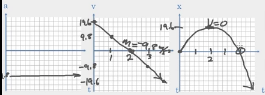
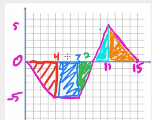
This video explains how to do a bunch of different one-dimensional problems that all revolve around being able to look at a graph of acceleration, velocity or position versus time and figure something out. Sometimes you'll be using the slope of the velocity graph to estimate acceleration. Other times you'll be using area under the velocity curve to calculate position. Lots of fun, including multiple choice questions you'd see on AP test!

These videos cover graphs of acceleration, velocity and position in a similar way to how your calculus professor made you sketch the derivative of a function. The key takeaways are that you can use the slope of a curve to sketch its derivative, or you can use the "area under the curve" to plot its integral.

Part of the course(s): Physics

Average Velocity Vector Problems (i & j)

Let's face it, at this point we've all calculated average velocity a time or two or ten, amiright? Well, hold onto your hat, because now we're going to do it with i & j-style vectors. Get ready! Omg, totally sweet. Anyways, it's basically the same as always, where you have to divide displacement by Δt. "What," you may ask, "is displacement, and how is it different from the position vector that has i's and j's in it?" Well, this is the video for that too!

Vector Acceleration & Velocity Problems
(i & j)

This video covers the problems where they give you an acceleration or velocity vector (in i & j form, naturally), and maybe an initial position vector (also in i & j form, because that sucks more), and then they ask you to figure out the velocity or position a little while later. Also covered, for those few of you who actually have to use calculus in your physics class, is using derivatives to get velocity from the position vector.

Calculating Angles of i & j Vectors

This video shows you how to take a vector with i's and j's in it and calculate the angle (a.k.a. "direction") of the vector. This is a little bit different than your usual physics vector angles, because in this particular section (kinematics with i and j vectors), you're usually supposed to give the angle "relative to the i unit vector".

Interpreting Acceleration & Velocity Vectors with i's & j's

Before getting into the rather painful business of doing 2-D kinematics vector problems full of i's and j's, it's kind of important to understand what the heck i and j are. (Something tells me that it wouldn't clear things up to tell you that they're also called the "unit direction vectors".) And how you can use them to get the vector components you'll be plugging into your kinematics equations to solve the questions.

Your class might not cover this, so make sure you have to know this before watching these videos, because this is an annoying topic. Basically it's 2-D kinematics, kind of like you would find in the projectiles chapter, except EVERYTHING is a vector with i's and j's in it, and EVERYTHING is pointlessly confusing! It's like your prof and book went out of their way to make 2-D motion as obscure and abstract as possible. Makes you wonder if they're out to get you. (Before this chapter, I would have said they aren't, but after this chapter, I'm not sure...)

Part of the course(s): Physics

Common Trick Ramp Question: Ramp vs Freefall

This video covers a very particular type of ramp problem which you will definitely see at some point in the kinematics chapter, a question which you have perhaps pondered yourself while sitting in lecture: A steep ramp has more acceleration than a shallow one, but do you end up going faster at the bottom? Watch this video and you'll never look at the X Games the same way again.

This video appears on the page: Frictionless Ramp Problems (No F=ma)

Kinematic Ramp Problems Without Friction: g=a⋅sinΘ

This video covers kinematic ramp problems (no friction, no F=ma), where you have to do things like solve for how long it takes for a crate to slide down a frictionless ramp, or figure out how fast a skier is going after they've gone down a particular mountain.

This video appears on the page: Frictionless Ramp Problems (No F=ma)

Gravity Components On A Ramp

If you only watch ONE ramp video (like your test starts in 15 minutes), this is the one to watch. Why? Because the most common and most damaging mistake I see students make on ramp problems is to mess up the components of gravity. That part where you draw a right triangle under the object which allows you to break up gravity into its X & Y components. So watch this video all the way through, and work the problems with me!

This video appears on the page: Frictionless Ramp Problems (No F=ma)

This chapter covers kinematic ramp problems WITHOUT friction or forces, and most importantly, it explains how to draw those dang triangles for ramp problems, where you have to break g into its X and Y components. Problem types covered are kinematic setups like: A skier heads down a 20° slope, how fast is she going after 30m; or, A box slides down a 15° ramp, how long does it take to reach the bottom? If you're using F=ma to solve all kinds of free body diagram situations on ramps, then look for the ramps videos further down.

Part of the course(s): Physics