Author Archives: hangtime

Potential Energy In Rotational Motion

In linear motion, the main type of potential energy we saw was from gravity (mgh). While a rotating wheel doesn't really get mgh from spinning, that doesn't mean your professor can't find a way to use potential energy anyways, by hanging a mass off of a heavy wheel, or by having the wheel be lopsided, or with a rotational spring powering a catapult in a Pumpkin Chucking contest (½kx2), or a wheel rolling down a hill (next chapter).

This video appears on the page: Energy, Power & Work In Rotational Motion

Kinetic Energy in Rotational Motion (KE=½Iω2)

As we've seen before, in rotational problems, all the formulas are the same as for linear problems except the letters are different. Kinetic energy is no different, just swap rotational velocity (ω) for v and moment of inertia (I) for m and you're good to go.

This video appears on the page: Energy, Power & Work In Rotational Motion

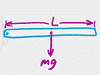
Find Final Velocity of Falling Beam Using Energy

We return to the beam problem, but instead of looking at the instantaneous acceleration at the moment of release, we instead calculate final velocity after the beam has rotated downwards. If you aren't sure what potential energy and kinetic energy are, skip this video for now because there will be lots more rotational energy videos later in physics.

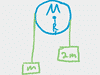
Find Tensions In Strings When Two Different Masses Hang From Wheel

This is the toughest one! THREE objects, so you need THREE free body diagrams, each with their own coordinate axes that need to match up and use the right hand rule. And worst of all, one of the objects is rotating. Start with a fresh sheet of paper for this one!

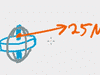
Find Spin Rate of Gyro Toy Pulled By A String

This problem only has one mass, thank goodness, but it's pretty tough because it also unites the worlds of linear and rotational physics: How does the linear pull of a string turn into rotational velocity? And how do we convert between the length of the string and the corresponding angular quantities? Is it even possible?*

*just kidding, I explain it in the video

Find Acceleration of Mass Hanging From String Wrapped Around Solid Disk

In this problem, worlds collide... The mass will fall in a straight line like any other hanging mass and will therefore need ΣF=ma to calculate its acceleration. The wheel is in its own world of rotations and moments of inertia, so its world is governed by ΣΤ = Iα. How can these two worlds unite to allow us to solve for acceleration?

Initial Angular & Linear Acceleration of Beam Falling when Pivot On One End

In this video we calculate the acceleration that would be felt by a small spider or lady bug who happened to be hanging out on a hinged beam if it suddenly starts swinging downwards towards the floor.

General Advice on Fancy Torque Problems

The hardest thing about crazy torque problems with masses hanging off of each other: where to start? Since the problems in the other videos in this chapter take so long to solve, sometimes the forest gets lost for the trees, so in this video I slow things down to look at "the view from 30,000 feet" to see what all these problems have in common and the two or three tricks then all require.

These videos cover difficult rotating body problems where you've got a rotating mass, like a heavy wheel or a kid's gyro toy, that gets rotated or "spun up" by a linear force like a rope or gravity. Examples covered:

Part of the course(s): Physics

Net Torque

In this video I introduce the concept of net torque and we do some quick net torque calculations for various word problems and situations.

This video appears on the page: Net Torque & Rotational Kinematics

Net Torque T=Iα Kinematic Problems

In these problems we analyze the angular acceleration and velocity of objects when they are subjected to a force. In the last one we bring kinematics to the party by calculating the spin on a tennis ball after it is struck and spun by a racket.

This video appears on the page: Net Torque & Rotational Kinematics

In this chapter we learn how to deal with torques when there are more than one torque acting on a single object. Much like we did with net forces, first you have to add and subtract the various torques to combine them into a single net torque before you apply Kinematics to them.

Part of the course(s): Physics

Right Hand Rule for Torque

This video makes almost no mention of the 70's cult classic "Over The Top," instead focusing almost entirely on how to use your right hand to figure out if a particular torque should be positive or negative, for the purposes of being able to add them up and/or cancel them out when calculating net torque. Oh, I'm sorry, "Over The Top" is actually from the 80's, I'll try to remember to go back and edit that earlier sentence later. The last thing you want to do on a physics website is to make a factually erroneous reference to what may or may not be a great film, obviously.

This video appears on the page: Torque

Moment vs Moment of Inertia vs Torque

This video is a really quick explainer on the difference between these terms, which are either synonyms or sound like they should be.

This video appears on the page: Torque

Basic Torque Calculations (T=F˙r)

In this video we temporarily set aside our discussions of classic film in favor of doing some actual physics problems involving torque. We calculate the torque when we're given a force, and we also do the opposite where you calculate a force generated by a torque.

This video appears on the page: Torque

Torque Is Twist

This video explains what torque is in general terms and also utilizes a few illustrative examples - one of which may be the classic film "Over The Top" - to explain where torque comes from and explain generally how we'll use it in physics class.

This video appears on the page: Torque

In addition to explaining what torque means and how to calculate it, in these videos we also endeavor to explore torque through the existential lens of the 1980's classic "Over The Top", a film exploring professional arm wrestling and truck driving (yes, arm wrestling) through a family story involving a young boy and his estranged father. This masterpiece stars Sylvester Stallone, whom many of you young punks won't know is the star of Rocky, another movie you may not know.

Part of the course(s): Physics

Parallel Axis Theorem

This is a topic that will get mentioned in pretty much every physics course but not all teachers will ever make you use it. The Parallel Axis Theorem allows you to calculate the moment of inertia if an object is rotated about an axis that doesn't go through its center of mass.

This video appears on the page: Moment of Inertia

Calculating Moment of Inertia

This video explains the nitty gritty of how to use the various formulas to calculate moment of inertia of various shapes. Sometimes it can be confusing, especially when you're given two very similar looking formulas - such as for a sold sphere vs a hollow one - so it's important to do a few examples and explain when to be careful.

This video appears on the page: Moment of Inertia

What Is Moment of Inertia (I)

This video explains what moment of inertia means, what it's for, and the factors that contribute to whether than object has a high or low moment of inertia. Also explained: the difference between mass (m) and moment of inertia (I).

This video appears on the page: Moment of Inertia