Monthly Archives: February 2017

Problems About Object Getting Pushed or Pulled Across Floor

This video lays out the basic strategy of how to solve F=ma problems where an object is being dragged across level ground: 1) how to draw the free body diagram and make sure you don't forget anything; 2) setting up your F=ma equations in both X and Y; 3) using substitution to solve the system of equations.

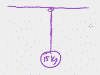
Find Angle of Pendulum Hanging In Accelerating Boat

In most of the "stuff hanging from ropes" problems, acceleration is zero, which makes the math pretty simple. But in this one, the boat is accelerating sideways (other variations may include a bus or truck), so the angle of the rope is caused by acceleration.

Find Tension In Ropes Suspending Mass Between Two Walls

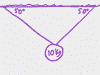
This video covers when a mass is suspended in the middle of a rope that's strung between two walls. Notable because you can get an infinite tension in the rope.

Trick Question: Find Tension When One Rope Is Vertical

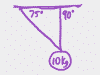
This video covers a trick that you'll usually see some version of in your physics class. In a nutshell: when one rope is vertical, the other gives you some interesting numbers.

Find Tension When Mass Hangs From Ropes At Different Angles

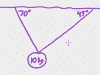
This video covers how to solve for the tension in the two ropes suspending a mass if the ropes are at different angles.

Find Tension When Mass Hangs From Two Symmetrical Ropes

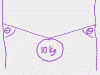
This video covers what to do when a mass is hanging from two angled ropes which are symmetrical, i.e. the ropes are each at the same angle to the ceiling, thus the tensions will be the same.

Find Tension When Mass Hangs From Single Rope

This video just covers what to do for one type of problem: finding the tension when a mass hanging from a single rope.

Intro to Force Problems About Objects Hanging From Ropes

This video quickly outlines what we'll be doing in these "find the tension in the one or more ropes something is hanging from" problems: set up the free body diagram, write your net force equations, and solve!

This chapter covers the word problems that the Forces chapter in physics class usually starts with. Given acceleration and mass, you may be asked to solve for net force, or given a bunch of different forces, you might need to find the net force (by combining the vectors into a single vector using vector components). Also covered are a favorite physics problem type: calculate the weight of something on the moon.

Part of the course(s): Physics

2D Net Force Problems

This video lays out how to combine several force vectors into a single "net force" vector. It's the same thing you've done before with vectors, where you have to break them into components and then combine X's with X's and Y's with Y's.

This video appears on the page: Basic F=ma Problems

Gravity On Other Planets Force Problems

There has never been a physics student who didn't get at least one "gravity on the moon" problem in the forces chapter. Sometimes they give you the mass of an object on earth then ask how much it would weigh on the moon (or Mars) (or Jupiter). Other times they give you the weight on the moon (or Mars) (or Jupiter) and ask you how much it would weigh on Earth. Either way, not too bad.

This video appears on the page: Basic F=ma Problems

Basic F=ma Word Problems

This video covers the most basic type of force problems, where they ask you to solve for either mass, force, or acceleration and then give you the other two so that you can plug-and-chug through the F=ma formula. They often make you do a bit of kinematics in these problems, usually to solve for acceleration prior to F=ma.

This video appears on the page: Basic F=ma Problems

This chapter covers detailed examples of various problems that involve objects hanging from one or two ropes:

Part of the course(s): Physics

Rope & Pulley Free Body Diagrams

This video shows you how to do the free body diagrams for two common problems involving two masses attached by a pulley: Atwood machines and inclined plane. The key to both is to set up your coordinate systems correctly, which unfortunately is confusing, but I've never found a better way to get these right.

This video appears on the page: Free Body Diagrams

Multiple Object Free Body Diagrams

It seems like every book and class uses the same example where there are three boxes being pushed from one end. This video shows you how to divide the problem up into three separate free body diagrams so that you can carefully label and account for the forces on all three boxes.

This video appears on the page: Free Body Diagrams

Circular Motion Free Body Diagrams

This video covers how to do free body diagrams for objects being swung in a circle: a yo-yo and a car. The really key takeaway, in case you don't have time to watch, is to not put the "fictitious" centrifugal force on your free body diagram.

This video appears on the page: Free Body Diagrams

Ramp Problem Free Body Diagrams

This video covers free body diagrams for problems where an object is sliding up or down a ramp. I know what you're thinking: "Didn't we cover ramps before?" Sort of. And you should definitely watch that video. However, that was just kinematics; this one shows you how to draw the forces, including more practice with the X- and Y-components of gravity (mg).

This video appears on the page: Free Body Diagrams

Basic Free Body Diagrams

This video shows you how to do free body diagrams for variations on the old "crate on a level surface" genre of force problem: a crate at rest, a crate being pushed, a crate being pulled by an angled rope, with and without friction. Also included: free body diagram for a crate suspended from the ceiling by angled ropes.

This video appears on the page: Free Body Diagrams

What Is A “Free Body” Diagram?

You've probably wondered this. Most of the time when you do free body diagrams, it will be for problems similar to ones you've done before, so it basically becomes like a bad habit. But it will really impress your teacher if you know what's so free about those diagrams.

This video appears on the page: Free Body Diagrams

This chapter covers everything you could need to know about free body diagrams, starting with why the heck the darned things are called free body diagrams to begin with. Then each video shows you how to do the free body diagram for a common type of problem, from sliding boxes to inclined ramps and pulley systems.

Part of the course(s): Physics